


Today we are continuing with our processing of 2 Kings, and the question that we keep leaning into through this series is How will I persist?
Life relentlessly pleads for persistence in moments such as looking for a job after multiple rejections, recovering from a major setback or failure, learning a new skill that doesn’t come naturally, working through a difficult season in a marriage, training for a race or fitness goal, paying off debt over several years, finishing a college degree or certification program, rebuilding trust after a relationship is broken, starting a new business from scratch, or caring for a loved one through a long illness. The list could go on and on and on, with many different specific things on each of our individual lists. Life pleads for persistence!
And in 2 Kings, we get a window into moments of choice about how will I persist? Will I persist in looking to God when I am in need, or will I persist by looking elsewhere (ch 1)? Will I persist in being discipled, mentored, and coached, or persist in not giving the effort (ch 2)? Will I persist in holding off in bringing things to God until I am truly desperate, or will I persist in bringing things to God early (ch 3)? Will I persist in being part of God’s miraculous, or will I persist in not being a part (ch 4)? Will I persist in seeking God while feeling like an outsider, or will I persist in disqualifying myself (ch 5)? Will I persist in bringing my fears and trusts to God and community, or will I persist in isolating myself (ch 6, 7, 8)? And today, will I persist in compromise, or in not compromising? (When compromise involves morals, convictions, or integrity, it usually refers to yielding or sacrificing something that should not be surrendered.)
Today as we pass through 2 Kings 9-10, the text is heavy. There is so much death, killing, and violence, which can be really hard to swallow. A lot of things that can be processed from this extreme narrative, including justice for the marginalized, consequences of hurting others, the weight of judgement and the scale of grace, the cost of obedience, and the cost of disobedience. But we are going to focus on a moment at the end of the narrative where a “however” is dropped. There was change, progress, refining, and focus—and still a moment of “however.”
Today we are going to process scenarios where it can be tempting to compromise in order to hold things together. The question of how will you persist in holding things together can be muddled by things like insecurity, selfishness, fear, shame, doubt, and feelings of inferiority. We will look at questions like these: What are we sacrificing to preserve what we have? What are we compromising because we believe it’s necessary to continue?
But before we come to that, let’s build some foundations with a survey! (As always, these are not intended to diagnose, but to help us dialogue and process together.)
Here are three areas in life that are complex to hold together: family, faith, and finances. “Hold together” might be a little abstract, so I want to define it this way: to maintain health and stability over time.
For each of the three areas—family, faith, and finaces—there are 10 elements. I want you to give each one a score from 0 (this doesn’t carry any weight in holding “it” together) to 7 (this is absolutely essential in holding “it” together).
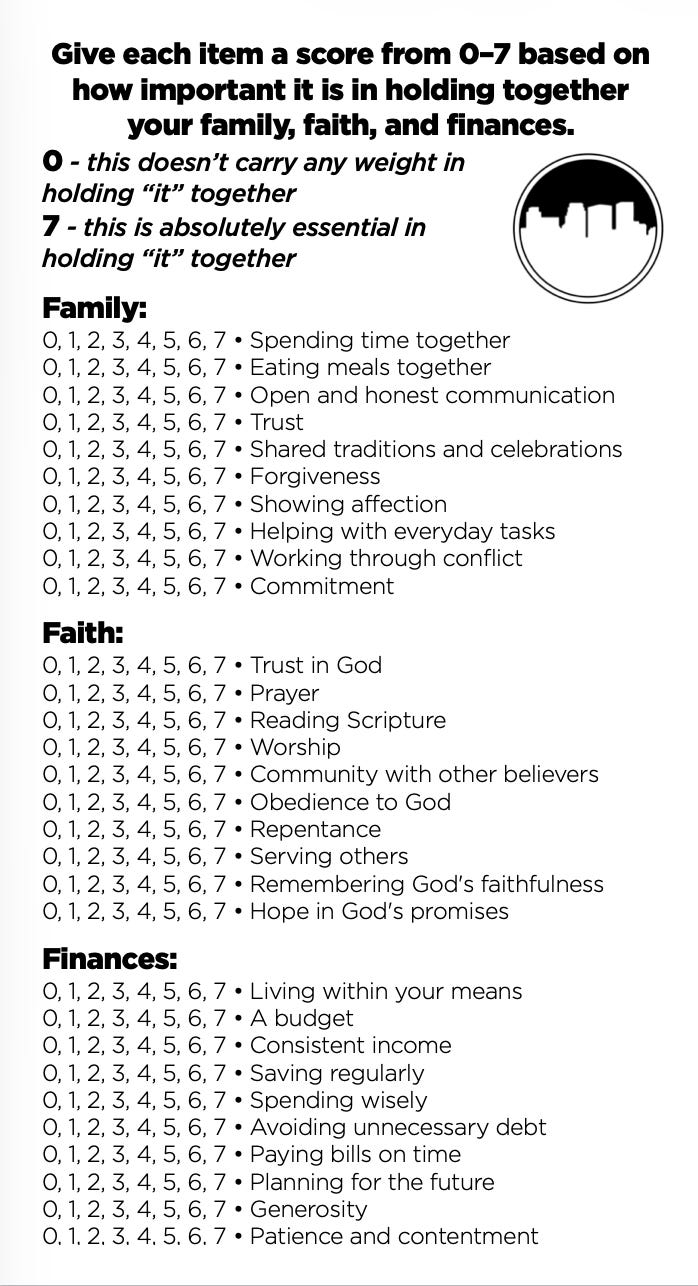
Let’s process what we just did a little.
What stands out as you look at your scores?
What are the costs of overestimating or underestimating the importance of something in maintaining health and stability over time?
600 years is a long time. But the people in our text in 2 Kings would have known the narrative from Exodus 32, about 600 years earlier. Just like we know stories from our history even though we weren’t there—like the Boston Tea Party and the signing of the Declaration of Independence—the same was true for the people of Israel and Judah as it relates to the stories in Exodus.
Exodus 32 takes place shortly after God rescued Israel from Egypt and made a covenant with them at Mount Sinai. Moses was up on the mountain meeting with God. I don’t want to diminish the scale and complexity of this statement, but for now, this is our context. And while Moses was on the mountain receiving God’s instructions, the people became impatient. They gathered around Moses’ brother Aaron:
When the people saw that Moses was so long in coming down from the mountain, they gathered around Aaron and said, “Come, make us gods who will go before us. As for this fellow Moses who brought us up out of Egypt, we don’t know what has happened to him.” (Exodus 32:1)
Aaron didn’t seem to have any hesitation. Can you feel his desire to keep things together? So he told everyone to gather their gold jewelry, which he then melted down and formed into the shape of a calf.
He took what they handed him and made it into an idol cast in the shape of a calf, fashioning it with a tool. Then they said, “These are your gods, Israel, who brought you up out of Egypt.” (Exodus 32:4)
An altar was built. Sacrifices were made to the calf. The people celebrated. Meanwhile, God told Moses what the people down the mountain were up to.
Then the Lord said to Moses, “Go down, because your people, whom you brought up out of Egypt, have become corrupt. They have been quick to turn away from what I commanded them and have made themselves an idol cast in the shape of a calf. They have bowed down to it and sacrificed to it and have said, ‘These are your gods, Israel, who brought you up out of Egypt.’ (Exodus 32:7-8)
And God was angry!
“I have seen these people,” the Lord said to Moses, “and they are a stiff-necked people. Now leave me alone so that my anger may burn against them and that I may destroy them. Then I will make you into a great nation.” (Exodus 32:9-10)
And then there was a crazy moment where Moses pled for God to change His mind, reminding God of the covenant He’d made with Abraham, Isaac, and Jacob, and how He wouldn’t want the Egyptians to think He’d brought the Israelites out into the wilderness just to kill them. And God relented. Then Moses came down the mountain with the tablets of the law written by God, and he saw the people.
When Moses approached the camp and saw the calf and the dancing, his anger burned and he threw the tablets out of his hands, breaking them to pieces at the foot of the mountain. And he took the calf the people had made and burned it in the fire; then he ground it to powder, scattered it on the water and made the Israelites drink it. (Exodus 32:19-20)
That wasn’t the end of the story, but I wanted to share that much because the people in 2 Kings would have known this story. It was their cultural lore, part of who they were.
I want process for a moment. In the survey we did, we talked about the importance of good things to keep things together. But what about ‘bad’ things, like when Aaron jumped at the idea of making a god? Let’s discuss.
What fears or pressures might lead someone to do something “bad” in order to hold things together?
Before we get to our (admittedly rough) text in 2 Kings 9-10, I want to review some context from 1 Kings 21, when Ahab wanted Naboth’s vineyard and was willing to pay anything for it, but Naboth said no. Ahab was pouting about it, so his wife Jezebel said she would take care of it. She set events in motion that led to Naboth being killed even though he was innocent, and Ahab was able to claim the vineyard. Elijah the prophet declared great judgment on Ahab for this, but Ahab repented, so God was gracious to him but declared that justice would come to his son, and 2 Kings 9-10 is that justice finally coming around.
Right away in 2 Kings 9, Jehu was anointed king of Israel by Elisha (even though Ahab’s son Joram, the king of Israel, was still alive).
The prophet Elisha summoned a man from the company of the prophets and said to him, “Tuck your cloak into your belt, take this flask of olive oil with you and go to Ramoth Gilead. When you get there, look for Jehu son of Jehoshaphat, the son of Nimshi. Go to him, get him away from his companions and take him into an inner room. Then take the flask and pour the oil on his head and declare, ‘This is what the Lord says: I anoint you king over Israel.’ Then open the door and run; don’t delay!” (2 Kings 9:1-3)
This anointing was a shock. Jehu wasn’t Ahab’s son. He wasn’t part of the royal family line or legally in line for the throne. And now he would administer some uncomfortable justice for the terrible things that Ahab and his family had done.
Jehu got up and went into the house. Then the prophet poured the oil on Jehu’s head and declared, “This is what the Lord, the God of Israel, says: ‘I anoint you king over the Lord’s people Israel. You are to destroy the house of Ahab your master, and I will avenge the blood of my servants the prophets and the blood of all the Lord’s servants shed by Jezebel. The whole house of Ahab will perish.” (2 Kings 9:6-8)
The rest of chapter 9 and most of chapter 10 are pretty rough, even gruesome. Joram was killed by Jehu after being confronted in Naboth’s field (2 Kings 9:24–26). Ahaziah of Judah (Ahab’s grandson) was killed while fleeing Jehu after aligning with Joram (2 Kings 9:27–28). Jezebel was thrown from a window and killed, fulfilling a prophecy of judgment (2 Kings 9:30–37). Seventy sons of Ahab were executed by the elders of Samaria under Jehu’s order (2 Kings 10:6–7). All remaining relatives of Ahab were slaughtered, erasing his dynasty (2 Kings 10:11). Ahaziah’s relatives—42 men—were killed at Beth Eked (2 Kings 10:12–14). And the prophets and worshipers of Baal were deceived into a gathering and killed in a Baal temple purge (2 Kings 10:18–28).
Two chapters of purging. Ahab and Jezebel had done all kinds of evil things, and in these chapters there was justice… and yet, this is complicated and difficult. But the moment that we are actually going to focus on comes at the end of all of this—the “however” moment:
So Jehu destroyed Baal worship in Israel. However, he did not turn away from the sins of Jeroboam son of Nebat, which he had caused Israel to commit—the worship of the golden calves at Bethel and Dan. (2 Kings 10:28-29)
When Israel divided, Judah had Jerusalem and the temple, but Israel didn’t have a religious gathering point. Jeroboam in 1 Kings 12 made a plan to hold the people together:
Jeroboam thought to himself, “The kingdom will now likely revert to the house of David. If these people go up to offer sacrifices at the temple of the Lord in Jerusalem, they will again give their allegiance to their lord, Rehoboam king of Judah. They will kill me and return to King Rehoboam.” After seeking advice, the king made two golden calves. He said to the people, “It is too much for you to go up to Jerusalem. Here are your gods, Israel, who brought you up out of Egypt.” One he set up in Bethel, and the other in Dan. (1 Kings 12:26-29)
Jehu lived 80-100 years after Jeroboam. And in this moment, after justice had been administered and the kings of Israel and Judah were killed, there was the possibility that the two kingdoms could have been reunited. Maybe they could have been unified. However:
However, he did not turn away from the sins of Jeroboam son of Nebat, which he had caused Israel to commit—the worship of the golden calves at Bethel and Dan. (2 Kings 10:29)
No need to go to Jerusalem. No need for Judah. We have the calves.
There appears to be several things at work here: fear of the unknown, wanting to keep control, preserving the status quo, insecurity, and pride. Let’s pause and process.
How do these things impact efforts in holding things together: fear of the unknown, wanting to keep control, preserving the status quo, insecurity, and pride?
In Matthew 5-7, Jesus shares His Sermon on the Mount. At the very end of it, He tells us how to hold it all together: Hear these words and put them into practice!
“Therefore everyone who hears these words of mine and puts them into practice is like a wise man who built his house on the rock. The rain came down, the streams rose, and the winds blew and beat against that house; yet it did not fall, because it had its foundation on the rock. But everyone who hears these words of mine and does not put them into practice is like a foolish man who built his house on sand. The rain came down, the streams rose, and the winds blew and beat against that house, and it fell with a great crash.” (Matthew 7:24-27)
We have processed a lot today. We talked about the costs of overestimating or underestimating the importance of something in maintaining health and stability over time. We talked about what is happening inside a person when he or she decides to do something bad in efforts to hold everything together. We saw how Jehu’s ‘however’ moment was potentially fueled by fear of the unknown, wanting to keep control, preserving the status quo, insecurity, and pride. And we read Jesus’ key to holding it all together.
In the survey we did earlier, you identified things that help hold things together. We can know what good things are needed, and yet life can get in the way of us living those out, and we can find ourselves compromising. Now I invite you to process.
What are some keys for you to grow in being good at holding things together (maintaining health and stability over time) without compromising?
Take It Deeper Questions
Read Romans 12:1-2.
Who are some people that have inspired you? What have they done? What stands out to you about them? How have they impacted your life and who you are?
Take a moment to marvel at God’s mercy. What has it accomplished? What stands out to you about God’s mercy? How has it impacted your life and who you are?
What breaks if a person tries to live a transformed life and ignores God’s mercy?
What happens if a person tries to live a transformed life and fully embraces God’s mercy?
How are you challenged, focused, encouraged, and/or confused by this text?
Bible Reading Plan
Matthew 5 • Kingdom Character
John 15 • Abiding in Christ
Colossians 3 • Put On the New Self
Ephesians 4 • Walk in New Life
Philippians 2 • Mind of Christ
2 Kings 11 • Hidden King Restored
2 Kings 12 • Temple Repair and Reform