


Today we are continuing our processing and conversation through the book of 2 Kings. We are not by any means covering everything in this book—which isn’t a bad thing. Our intention is to open the door to processing. Let me encourage you to read and reread Scripture for yourself. There’s so much value in that!
So as we’ve been moving through this book, we’ve seen over and over the relentless spiral away from God. What is this pointing toward? It’s not to show that we’re bad; it’s to show our need for a savior, and to highlight God’s relentless efforts to have relationship with us.
The question we’ve been asking repeatedly in this book, as a theme, is How will I persist? Life pleads for persistence, whether that’s in relationships or character or health or work or walking with God, and the narrative of 2 Kings makes it clear that whether we’re talking about the king or the culture or the systems and practices, they all fall short.
This brings us to a complex and vital tension: we need God’s help and grace—and what we do, or how we persist, has a huge impact. It matters. Both of these things are true.
Today we’re going to be focusing on Hezekiah—one of the few good kings of Judah.
Hezekiah trusted in the Lord, the God of Israel. There was no one like him among all the kings of Judah, either before him or after him. He held fast to the Lord and did not stop following him; he kept the commands the Lord had given Moses. And the Lord was with him; he was successful in whatever he undertook. He rebelled against the king of Assyria and did not serve him. From watchtower to fortified city, he defeated the Philistines, as far as Gaza and its territory. (2 Kings 18:5-8)
And we will see Hezekiah be a godly leader, stand up to Assyrian threats, be protected miraculously from the Assyrians, and be healed from a potentially lethal illness. And after all this, we will see him make a dumb move out of pride and insecurity and be okay with future consequences as long as he personally doesn’t have to suffer.
That “dumb move” was part of the process of his people—the people of Judah—eventually being taken into exile. And I’m tempted to say, Really? I thought things were going so well! What happened?
We’re not going to use this moment to pile on shame or guilt or the weight of being close and then blowing it. Instead, we’re going to point to the value of persistent personal growth, and to our need for grace.
Persistent personal growth isn’t fueled by being disappointed in yourself, it’s not about earning God’s love, and it’s not about becoming perfected in order to participate in God’s work. It’s the willingness to remain open to what God has yet to reveal; to correct, to change, to discover that God’s grace is covering the areas of my life I have yet to submit to Him.
The highs of life—our good moments—don’t negate the need for continual growth. Hezakiah’s greatness didn’t mean he was above failure in the next moment. 2 Chronicles 32 (covering the same timeframe as 2 Kings 20) exposes the struggle:
But Hezekiah’s heart was proud and he did not respond to the kindness shown him; therefore the Lord’s wrath was on him and on Judah and Jerusalem. (2 Chronicles 32:25)
So, persistent personal growth and God’s grace.
To help us start to process and bring us to a shared starting point, I’m going to give you a list of life moments that you may or may not have experienced. I want you to give each one a score reflecting how much you grew because of this moment.
I’m not asking how you grew, or if you continued to grow, or if it was life-changing. I’m leaving things a little vague on purpose.
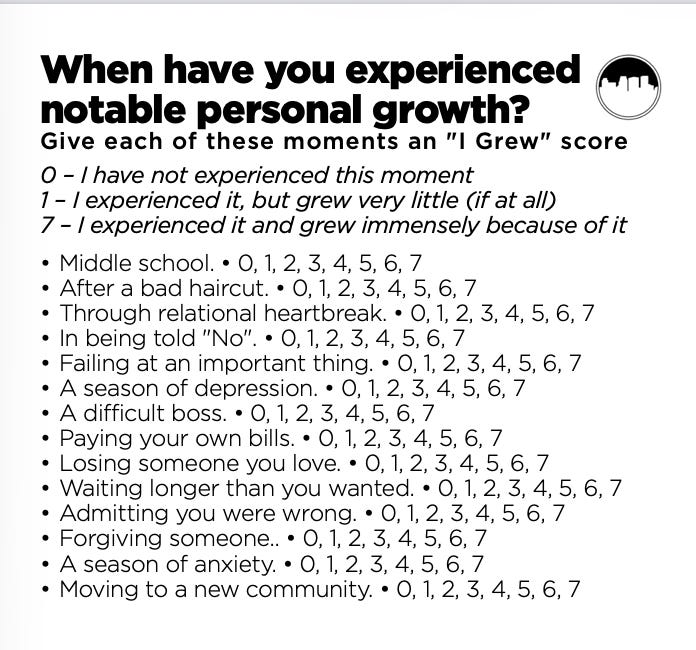
Now, let’s process this together.
What stands out as you look at your answers?
When did you grow a lot or not very much?
Choose one experience you scored high and one you scored low. What was different about those two experiences?
Let’s go a step further with this next question:
What is it about some difficult seasons that helps us grow?
Today we are going to come to a moment in Hezekiah’s life where something blurred and he “missed it.” So let me put these questions before you:
What are some of the things that can prevent us from experiencing personal growth?
When these obstacles show up, how do they keep us from growing?
This topic and these conversations remind me of what Jesus said in Matthew 18. He was nearing the end of His ministry and preparing His disciples for what was to come. They were really struggling to understand that Jesus was going to suffer. They were looking for a cultural and political revolutionary, someone who would take them to victory. They viewed God’s kingdom through the lens of earthly kingdoms. And so the disciples ended up squabbling about greatness.
At that time the disciples came to Jesus and asked, “Who, then, is the greatest in the kingdom of heaven?” He called a little child to him, and placed the child among them. And he said: “Truly I tell you, unless you change and become like little children, you will never enter the kingdom of heaven. Therefore, whoever takes the lowly position of this child is the greatest in the kingdom of heaven. And whoever welcomes one such child in my name welcomes me.” (Matthew 18:1-5)
The disciples were focused on who was going to be the greatest. And Jesus says that unless you become like a child, you won’t even get in. It’s not about immaturity or ignorance, but about a posture. A child doesn’t enter a room with status. A child is dependent, still learning, able to ask for help without feeling shame. So how are the disciples to prove that they are great? By becoming the kind of person who has nothing to prove. By staying dependent, teachable, and open to change.
What is the value of becoming childlike and welcoming those who are childlike?
It’s time to turn to our text in 2 Kings. A lot happens in chapters 18-20, and I’m going to summarize.
Hezekiah was king of Judah, the southern kingdom. He wasn’t another bad king in the seemingly endless line of terrible kings; he was a good one.
Hezekiah trusted in the Lord, the God of Israel. There was no one like him among all the kings of Judah, either before him or after him. (2 Kings 18:5)
During his reign, Assyria attacked and defeated Israel, the northern kingdom, and carried its people into exile. After Assyria was done with Israel, it was Judah’s turn. Hezekiah tried to keep the peace with this hostile superpower.
So Hezekiah king of Judah sent this message to the king of Assyria at Lachish: “I have done wrong. Withdraw from me, and I will pay whatever you demand of me.” The king of Assyria exacted from Hezekiah king of Judah three hundred talents of silver and thirty talents of gold. So Hezekiah gave him all the silver that was found in the temple of the Lord and in the treasuries of the royal palace. (2 Kings 18:14-15)
This is the same Hezekiah who is described as trusting God. Yet his first response to a threat appears to be manage it, pay it, make it go away. He reaches for the things he can control. Maybe his trust in God was real, but maybe his trust in God wasn’t automatic.
Paying off Assyria didn’t work. The Assyrian king sent an envoy to threaten Judah. He spoke where the people could hear, telling them how all their possible plans wouldn’t work to prevent Assyria from conquering them. An alliance with Egypt wouldn’t work:
“Look, I know you are depending on Egypt, that splintered reed of a staff, which pierces the hand of anyone who leans on it! Such is Pharaoh king of Egypt to all who depend on him.” (2 Kings 18:21)
And, the envoy continued, your dependence on God won’t help either:
“But if you say to me, ‘We are depending on the Lord our God’—isn’t he the one whose high places and altars Hezekiah removed, saying to Judah and Jerusalem, “You must worship before this altar in Jerusalem”? (2 Kings 18:22)
Hezekiah stripped your God’s temple to pay us off, and you think He will help you? No other nation’s god has helped them!
“Do not listen to Hezekiah, for he is misleading you when he says, ‘The Lord will deliver us.’ Has the god of any nation ever delivered his land from the hand of the king of Assyria? Where are the gods of Hamath and Arpad? Where are the gods of Sepharvaim, Hena and Ivvah? Have they rescued Samaria from my hand? Who of all the gods of these countries has been able to save his land from me? How then can the Lord deliver Jerusalem from my hand?” (2 Kings 18:32b-35)
Hezekiah responds with humble surrender to God. He and the people cry out to God with a beautiful and faith-filled prayer.
“It is true, Lord, that the Assyrian kings have laid waste these nations and their lands. They have thrown their gods into the fire and destroyed them, for they were not gods but only wood and stone, fashioned by human hands. Now, Lord our God, deliver us from his hand, so that all the kingdoms of the earth may know that you alone, Lord, are God.” (2 Kings 19:17-19)
They chose to trust, and the prophet Isaiah came and predicted their victory over Assyria, which came outside of any effort on their part.
That night the angel of the Lord went out and put to death a hundred and eighty-five thousand in the Assyrian camp. (2 Kings 19:35)
Wow.
Then we turn to chapter 20, and Hezekiah is sick and maybe dying. Isaiah told him to prepare for death, but Hezekiah cried out to God:
Before Isaiah had left the middle court, the word of the Lord came to him: “Go back and tell Hezekiah, the ruler of my people, ‘This is what the Lord, the God of your father David, says: I have heard your prayer and seen your tears; I will heal you. On the third day from now you will go up to the temple of the Lord. I will add fifteen years to your life. And I will deliver you and this city from the hand of the king of Assyria. I will defend this city for my sake and for the sake of my servant David.’” (2 Kings 20:4-6)
And as Hezekiah is doing better, an envoy from Babylon shows up with get-well gifts for him.
At that time Marduk-Baladan son of Baladan king of Babylon sent Hezekiah letters and a gift, because he had heard of Hezekiah’s illness. Hezekiah received the envoys and showed them all that was in his storehouses—the silver, the gold, the spices and the fine olive oil—his armory and everything found among his treasures. There was nothing in his palace or in all his kingdom that Hezekiah did not show them. (2 Kings 20:12-13)
At first this might seem like a moment that’s no big deal, but as we saw earlier from 2 Chronicles, this was actually a moment of pride and insecurity for Hezekiah. Assyria came with threats, and Hezekiah responded with fear. Babylon came with admiration, and Hezekiah responded with pride. When he felt powerless, he turned to God, but when Babylon made him feel important and valuable, it became all about him and his strength.
We can’t know everything happening inside him. Maybe he wanted Babylon’s approval. Maybe he wanted to appear stronger than he felt. Maybe he saw the possibility of a useful alliance. 2 Chronicles identifies pride in his heart, but pride and insecurity often work together: I need you to see how important I am because I am not secure enough to let you see my need.
The threat exposed his dependence. The attention exposed his insecurity.
What changes in Hezekiah’s posture between the Assyrian threat and the Babylonian attention? Why might admiration reveal something that hardship did not? Which is harder for us: trusting God when we feel powerless, or remaining humble when we feel successful and admired?
Isaiah the prophet called it out:
The prophet asked, “What did they see in your palace?”
“They saw everything in my palace,” Hezekiah said. “There is nothing among my treasures that I did not show them.”
Then Isaiah said to Hezekiah, “Hear the word of the Lord: The time will surely come when everything in your palace, and all that your predecessors have stored up until this day, will be carried off to Babylon. Nothing will be left, says the Lord.” (2 Kings 20:15-17)
And the story ends with a heart-wrenching response from Hezekiah:
“The word of the Lord you have spoken is good,” Hezekiah replied. For he thought, “Will there not be peace and security in my lifetime?” (2 Kings 20:19)
“It’s not my problem.” Even here his posture appears to turn inward: How will this affect me? What will happen during my lifetime? Will I personally be safe? The king who once prayed for the nations to know God now seems strangely disconnected from what will happen to the generations after him.
Again, there was so much good in Hezekiah. He was a righteous king, and God protected him from Assyria and healed his illness. And yet, pride and insecurity surfaced, and he dismissed the impact because it wouldn’t affect him.
How can seasons of success create a false sense of security and blind us to our ongoing need for growth and dependence on God?
Growth starts with a recognition of posture. Posture is directional—where are we headed? If we want to move forward, but are always facing sideways, we may be able to move that direction, but it’ll be much slower, more awkward, and maybe even painful.
When I feel threatened, do I reach for control? When I feel powerless, can I become dependent? When I am admired, do I begin performing? When I am corrected, do I become defensive?
Hezekiah moved through several of these postures—control, dependence, vulnerability, pride, and self-protection.
Sometimes persistent self growth starts with noticing where our hearts have moved, and what our posture has been. Which brings me back to what Jesus said about taking on the posture of a child.
I’d like us to quietly think about this for a minute, and then close with one final conversation. Consider these questions:
Which posture most threatens your growth right now: pride, fear, defensiveness, self-protection, or something else?
What is one way that posture makes it harder to depend on God?
What attitudes (conditions of the heart) do I need to be cautious of? How do they hinder my growth and my dependence on God?
How does awareness adjust my trajectory towards Christ?
Take It Deeper Questions
Read Philippians 4:6-7.
When have you faced a threat or crisis that felt too big for you to handle on your own?
What is usually your first response when bad news arrives—control, panic, denial, or prayer?
What does it look like to bring your fears honestly before God instead of carrying them alone?
Hezekiah was miraculously saved, then showed off his treasures to Babylon and ruined it. How does God’s rescue lead to pride later on?
How are you challenged, focused, encouraged, and/or confused by this text?
Bible Reading Plan
2 Kings 18 • Trust God Alone
2 Kings 19 • God Delivers
2 Kings 20 • Sickness, Sign, and Pride
Isaiah 37 • The Lord’s Answer to Assyria
Psalm 46 • God Our Refuge and Strength
Matthew 6 • Do Not Worry
2 Corinthians 12 • Strength in Weakness
2 Kings 21 • Manasseh’s Rebellion